How to Start a Dump Truck Brokerage Company: The Complete Guide
Most people who want to get into dump trucking think they need to buy a truck first. That is one way to do it, but it is not the only way. There is a second path that requires less startup capital, carries lower overhead, and can scale faster: becoming a dump truck broker.
A dump truck brokerage lets you build a real hauling business around capacity you do not own. You win the contracts, source the trucks, and manage everything in between. If you can build the right network and keep operations from falling apart, the margin is very much there.
This guide walks you through every step, from validating your market to the tools that keep a growing brokerage from running into chaos.
What Is a Dump Truck Broker?
A dump truck broker connects clients who need bulk material hauled with the owner-operators and small fleets who have the equipment to do it. The broker does not own the truck. Instead, they sell organized hauling capacity as a managed service.
Think of it as a staffing agency for trucks. You win the work, coordinate the trucks, and take the margin between. The client gets reliable hauling without managing drivers. The hauler gets consistent work without chasing contracts.
Unlike long-haul freight brokers who move palletized goods across interstate lanes, a dump truck brokerage is local by nature. Most brokers operate within a 50- to 150-mile radius, handling short haul jobs measured in tons or cubic yards. Clients are on job sites, not in logistics centers.
Step 1: Research Your Local Market
Is there enough unmet hauling demand in your area to justify building a broker business? Dump truck brokerage is hyper-local. A model that thrives in one city can be completely saturated over the next county. Before registering a business or recruiting haulers, spend real time confirming that unmet demand exists in your area.
Look for these demand indicators:
Active construction projects, road work, or commercial development
Quarries, gravel pits, and aggregate suppliers who need hauling logistics managed
Municipal contracts for public works, snow removal, or road maintenance
Developers doing land clearing, grading, or earthwork
Utility contractors working on pipeline or infrastructure projects
If general contractors in your market say they regularly struggle to find enough trucks, that is your signal. Dump truck work is often seasonal or project-driven, meaning fleet owners cannot justify buying 10 trucks for a 3-month job. Brokers who mix construction, quarry, and municipal clients tend to weather slow seasons better than those dependent on one type of work.
Step 2: Legal Setup and Licensing
Getting the legal side right from the start protects you from problems that are expensive to fix later. A dump truck brokerage is generally not subject to the same federal requirements as a regulated freight broker. You do not typically need to go through the FMCSA broker registration process or carry out the $75,000 surety bond required for interstate freight. That said, state rules vary, so confirm requirements with a local business attorney before dispatching a single truck.
Standard setup steps:
Form an LLC or corporation to separate your personal assets from business liability
Register for an EIN through the IRS
Open a dedicated business bank account
Get a business license from your city or county
Check your state DOT or DMV for any motor carrier or hauling broker licensing requirements
Purchase general liability insurance before signing any client contract
Insurance is not optional here. If a subcontractor has an accident on a job you sourced, you can be held liable as if they were your employee. Work with a commercial trucking insurance specialist to build the right coverage for a brokerage model, not just a standard business policy.
Step 3: Build Your Hauler Network
Your hauler network is your product. Without reliable, insured operators who show up and answer the phone, you cannot fulfill a single contract. Building this network is the most important activity in your first 60 to 90 days.
Where to find owner-operators and small fleets:
Visit local quarries, gravel pits, and asphalt plants. Ask who is already hauling there and approach those operators directly.
Post in local Facebook groups and on Craigslist for dump truck operators looking for consistent work.
Attend local Associated General Contractors chapter events to connect with both haulers and potential clients in the same room.
Use dump truck load boards to identify active operators already working in your market.
When onboarding a subcontractor, collect the following before their first dispatch:
Current Certificate of Insurance with at least $1M general liability
Completed W-9 for tax purposes
Copy of CDL and required endorsements
Vehicle registration and inspection records
DOT number verification, if applicable
Managing all of this across 15 to 20 subcontractors in a spreadsheet is where brokers start losing track. Insurance renewals lapse, CDL expiration dates get missed, and a truck that should not be dispatched ends up on a job site. A proper system for managing dump truck subcontractors keeps your hauler records accurate and your compliance gaps closed before they become a problem.
Step 4: Land Your First Contracts
The fastest path to a first paying job runs through relationships you already have. Cold outreach works, but a personal introduction closes in a fraction of the time.
Start with these approaches:
Talk to general contractors you know personally. Offer source trucks for one project as a trial run.
Contact civil contractors doing road work. They often need 5 to15 trucks for weeks at a time and struggle to find them consistently.
Bid on public works projects through SAM.gov and your state procurement portal for city and county contracts.
Reach out to demolition contractors. They move large volumes of material and are often underserved when it comes to reliable hauling coordination.
Partner with a quarry. Many quarries need someone to manage delivery logistics for customers who cannot arrange their own hauling.
For pricing, dump truck work typically runs $85 to $130 per hour depending on truck type and your region. Research local rates before quoting anything. Your first few jobs will likely come in at the lower end of the margin range, and that is fine. The goal early on is to build a track record, and as your reputation grows, finding bulk hauling contracts shifts from cold prospecting to referrals from clients you have already delivered for.
Protect your hauler relationships from the start. Never include subcontractor contact information in client-facing invoices. Clients going directly to your operators is one of the fastest ways to lose your margin.
Step 5: Get the Right Tools in Place
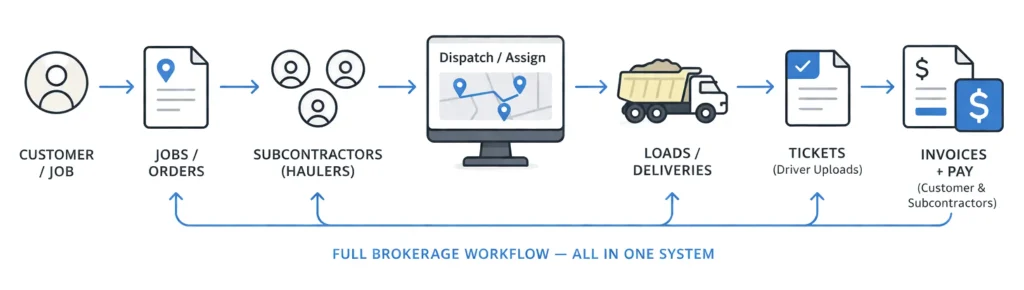
Paper and spreadsheets can carry you through the first couple of jobs. Once you are managing 5 or more trucks across multiple job sites at the same time, the gaps become costly.
Here is what typically breaks without a proper system:
Dispatching turns into a chain of individual calls and texts with no central visibility into what is happening
Tickets get lost, loads go unbilled, and margin quietly disappears
Reconciling what to pay each hauler takes hours of manual cross-checking
Invoicing falls behind, which extends your cash cycle by weeks
Good dump truck brokerage software brings all of this into one place. The features that matter most for a brokerage operation:
Visual dispatch scheduling that shows every hauler, every job, and every assignment in one view
Digital ticket management so every completed load is captured and connected to an invoice automatically
Subcontractor pay statements are generated from verified ticket data without manual calculation
Client invoicing is built directly from ticket records rather than from notes or spreadsheets
DOT compliance tracking to manage insurance renewals, CDL expiration dates, and certification deadlines across your hauler network
The tipping point for most brokers is around 5 to10 active trucks or 2 or more simultaneous job sites. At that point, operating manually costs more in errors and missed billing than software ever would.
How Do Dump Truck Brokers Earn Money?
The business model is straightforward. You quote the client at a rate per hour, per ton, or per load. You pay the hauler a lower rate for the same job. The difference is your margin.
Most brokers operate on a 10 to 20% spread. If a client pays $120 per hour per truck and you pay the hauler $100, you keep $20. Scale that across 8 trucks running 5 days a week, and the numbers move in your favor fast.
A broker managing 10 active subcontractors can generate $500,000 to $1.5 million in gross revenue annually, with retained margin typically falling between $50,000 and $300,000 depending on job mix and how cleanly the operation runs. Speed matters as much as volume, which is why automated dump truck invoicing directly affects how much of that margin you actually collect at the end of each billing cycle.
Common Mistakes New Brokers Make
Most early mistakes in dump truck brokerage trace back to one thing: taking on more work than the current systems can handle. These are the ones that appear most often:
Building a hauler network that is too thin. You need 2 to 3 times the trucks you plan to dispatch on any given day. Equipment breaks. Operators cancel. Always have backup haulers ready before committing to a job.
Skipping subcontractor paperwork. Dispatching a truck without a current COi file is a liability you cannot undo after the fact.
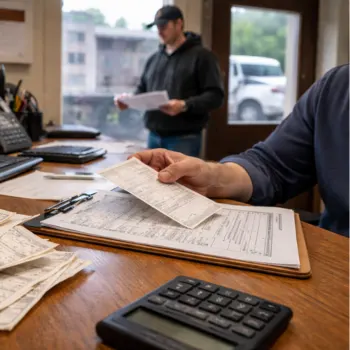
Letting tickets slip through. Every lost ticket is a load you delivered but were not paid for. This compounds fast across a multi-week job.
Waiting too long to invoice. Every week you delay invoicing extends your cash gap by the same amount. Daily or batch invoicing keeps money moving.
Sharing hauler contact details with clients. Keep your subcontractor relationships private. Managing that network is part of what clients are paying you to do.
Ready to Run Your Brokerage Without the Chaos?
Starting a dump truck brokerage is very achievable. The startup costs are lower than owning a fleet; the margin is real, and most markets have genuine demand for someone who can coordinate reliable hauling at scale.
The brokers who grew past the first 5 to10 trucks are the ones who invested in the right systems before the volume forced them to. Running manual works until it does not, and when it stops working, it costs more to fix than it would have to prevent.
Dump Truck Dispatcher is built for this model. It handles dispatch scheduling, digital ticketing, subcontractor management, invoicing, and compliance tracking in one platform, so you can run a growing brokerage without adding back-office headcount just to keep pace with paperwork.
If you are ready to build something that runs clean from day one, schedule a demo and see how it fits your operation.
Diesel is one of the biggest line items in any hauling operation. The problem is that prices move fast, and quotes do not. This post walks you through what a fuel…
Missing load tickets are a common reason for delay invoicing in hauling operations. In this article, you will see how missing load tickets delay invoicing, how that affects cash flow,…