How to Create Accurate Quotes for Dump Truck Hauls
Pricing mistakes are one of the fastest ways to lose money in the dump truck business. A few miscalculations on a job quote and you’re working the whole day just to break even or worse, at a loss.
Why does that happen? Most of the time, it’s because the quote didn’t factor in the real conditions of the haul — things like wait times, fuel, or the number of trips a truck can actually complete in a day.
If you want to protect your profit, you need to get serious about creating accurate quotes for dump truck hauls. And that means understanding your true costs, your daily capacity, and how to price each job based on real-world variables.
Before we get into the math, let’s break down what actually affects your rates.
What Impacts the Rate You Should Charge?
If you’re building quotes for dump truck hauls, the first thing you need to figure out is how many loads your truck can realistically complete in one day.
Your daily load count directly shapes your dump truck pricing strategy. Some haulers can manage eight to ten loads per day on short runs, while others average closer to four or five when the route is longer or the material is heavier.
Here are the biggest factors that impact your dump truck hauling rates:
Roundtrip distance and drive time. Longer hauls reduce your daily cycle count. A 20-mile haul takes more time and fuel than a quick job across town.
Loading and unloading delays. Waiting at the quarry or job site cuts into your working hours. The more time you spend idle, the fewer billable loads you can complete.
Material type. Light materials like mulch or topsoil are faster to load and easier to dump. Heavier materials like gravel, rock, or asphalt take more time and put more strain on your truck.
Truck capacity and configuration. Your truck’s legal weight limit and design matter. End dumps, belly dumps, and side dumps each operate differently and affect how fast you can load, haul, and unload.
Jobsite conditions. If you’re dealing with steep driveways, soft ground, or tight unloading spaces, you’ll spend more time maneuvering. That adds up quickly.
Every quote starts with knowing what a day on the job looks like. If you overestimate what your truck can do, you’ll lose time and money. But if you get it right, you’ll stay profitable and competitive.
Essential Costs to Factor Into Your Quote
A good quote covers more than just time and distance. If you’re not including all of your actual costs, you’re setting yourself up to break even or worse, lose money on every load.
Let’s break down the key costs that should always be factored into your quotes for dump truck hauls.
Fuel costs
Fuel can make or break your margins. In late 2024, the U.S. average price for diesel was $3.49 per gallon, according to the U.S. Energy Information Administration. That’s down from the record highs of over $5.75 per gallon back in 2022. These kinds of fluctuations are exactly why fuel should never be a fixed guess in your quote. Longer hauls, heavy materials, and even idle time at job sites all impact your fuel usage.
We cover this in more detail in our post on the cost of starting a dump truck hauling company, but the key takeaway is simple: review current diesel prices regularly and make sure they’re reflected in your job pricing.
Driver pay
Whether you pay your drivers hourly or by the load, labor is one of your most consistent and important costs. Hourly pay gives you flexibility when dealing with delays or long site waits. Per-load pay works well for faster cycles or experienced drivers. Either way, this needs to be built into your dump truck business pricing structure.
Maintenance and wear
The more loads you haul, the more stress your truck takes. Tires, brakes, suspension systems, and hydraulics wear down over time, especially when moving heavy materials like rock or asphalt. If you’re not including maintenance in your dump truck cost per load, you risk underpricing jobs. Even tire pressure plays a role in long-term costs, which is why many haulers explore tools that help monitor performance and reduce unexpected repairs.
Insurance and licensing
Insurance, permits, and registration are part of running a legal operation. Whether you pay them monthly or annually, they still need to be reflected in your job pricing. These fixed costs often go overlooked in the quoting process, especially for smaller fleets or new operators.
Traffic, weather, slow loaders, and jobsite backups are part of the day. Smart haulers add a buffer to each quote to absorb the impact of these unavoidable delays. It protects your schedule and your profit.
Your profit margin
A lot of new haulers focus only on covering their expenses without thinking about profit. But quoting without profit means you’re working for free. A solid dump truck pricing strategy always includes a margin that keeps your business healthy, even when things go off track.
Your quote should reflect what it actually takes to complete the work. That means knowing your per-load costs and applying them consistently to every job. When you price with full visibility, you avoid surprises and build trust with your customers.
What Others Are Charging and Why You Should Know
Knowing your own costs is essential, but it’s only half of the quoting process. To stay competitive, you also need to understand what other companies are charging for dump truck services in your area.
This doesn’t mean undercutting the market just to win a job. That’s a fast way to burn through fuel, wear out your trucks, and end up working long hours for very little return. Instead, think of it as competitive quoting — setting your rate based on both your value and what’s realistic for your region.
Start by searching for:
Hourly or per-load dump truck hauling rates in your city or county
Hauling prices by material type (gravel, topsoil, asphalt, demolition debris)
Quotes from competitors on platforms like Craigslist, Facebook Marketplace, or local trucking forums
Local contractor and subcontractor posts requesting hauling bids
Rates can vary depending on the type of job and location. For example, local hauling job pricing in a high-traffic metro area will often include extra buffer for time lost in congestion, while rural jobs might be faster-paced with lower per-load rates.
Once you get a sense of what others are charging, ask yourself:
Can I complete jobs faster?
Do I have newer or more reliable trucks?
Am I offering better customer service, tracking, or invoicing?
If the answer is yes, your rates can reflect that added value. You don’t have to be the cheapest — you just have to be worth the price.
If you’re using dump truck dispatch software that allows you to quote accurately, deliver on time, and track each job, that added professionalism becomes part of the service you’re selling.
Bottom line is quoting without knowing your market is risky. Use local price research as your starting point, then quote with confidence based on what sets your service apart.
Streamline Quoting with Dispatch Software
Creating quotes for Dump Truck Hauls used to be a messy, manual process. Spreadsheets, emails, phone calls, and sticky notes were the norm and mistakes were common. Quotes would get lost, pricing was inconsistent, and drivers often ended up hauling under unclear or outdated terms.
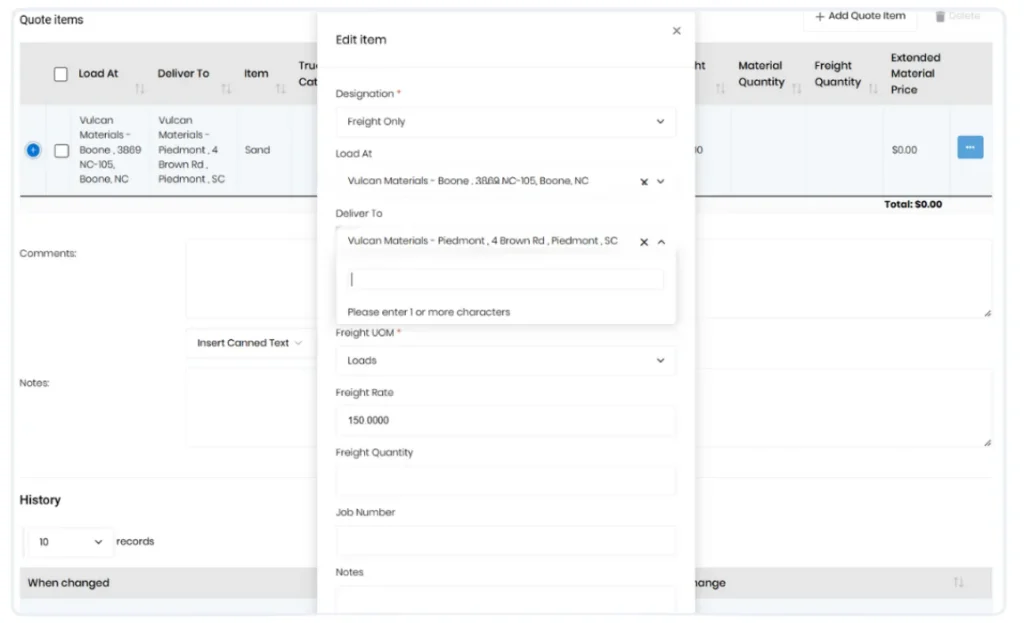
Now, tools like Dump Truck Dispatcher are helping haulers create quotes for dump truck jobs faster, with fewer errors and more clarity. If you’re still quoting by hand or relying on memory, switching to a software-based system can make a big difference in both time and accuracy.
Here’s how dispatch software improves your dump truck pricing strategy:
Customer-specific pricing. Set and save unique rates for each customer, including custom material costs, delivery zones, or project types.
Fuel surcharge automation. Instead of updating rates manually every time diesel prices change, fuel surcharges can be calculated and added automatically. This keeps your dump truck quote transparent and up to date.
Quote history and version tracking. Every time a quote is updated, edited, sent, or printed, a record is saved. You can go back and see exactly what was offered, and when in case questions come up later.
Job flow consistency. Once a quote is approved, it flows into the order and dispatch system without retyping. That means no details are lost and no pricing gets miscommunicated.
Branded, professional PDF quotes. You can quickly generate printable or emailable quotes with your logo, company info, and even a signature — all in one click. It’s like having a built-in dump truck quote calculator and branding tool in the same system.
Track actual deliveries vs. quoted quantities. See how much material has been delivered compared to what was originally quoted. This helps avoid overages, under-deliveries, or billing disputes down the line.
With a system like this, you’re using data, templates, and workflows to build quotes that are consistent, profitable, and ready to scale. It saves time, avoids errors, and gives your customers more confidence in the service you provide.
If you’re quoting multiple jobs a week or managing repeat clients, having the right tools in place is a game-changer.
Sample Estimates: Building a Simple Quote
Let’s say a contractor needs 120 tons of stone delivered from a quarry to a job site 20 miles away. In this case, your quote should focus on the freight rate and the total cost to complete the job, based on your actual capacity, fuel use, and labor.
Here’s a example using a per-ton freight rate:
Freight rate: $6.00 per ton Truck capacity: 20 tons per trip Estimated loads per day: 6 Tons hauled per day: 120 Daily revenue: 120 tons × $6.00 = $720
If you’re quoting by the hour, you might charge something like:
Now factor in your operating costs, including fuel, maintenance, and driver wages:
Fuel: At current diesel prices, expect to spend around $120–$150/day depending on route and load weight
Driver pay: Most local haulers pay hourly. For example, $30/hour × 10 hours = $300
Maintenance and wear: Estimate $40–$60 per load for tires, brakes, and general upkeep
Insurance, registration, and admin: Spread out, this might come out to $50–$80 per day
When you subtract your daily costs from your projected revenue, you can calculate your dump truck cost per load and ensure your quote includes enough margin. This is just a sample estimate to give you a general idea of how numbers can come together in a real-world scenario. Actual figures will vary based on your fuel prices, jobsite delays, truck type, and driver wages.
Final Thoughts: Better Quotes, Better Business
Creating accurate quotes for your hauling operation is one of the most important things you can do to protect your bottom line. Every job you take should not only cover your costs but also leave room for a healthy margin.
Whether you’re charging by the hour, per load, or per ton, your quote should reflect the real effort, time, and expenses involved. That’s why understanding how to charge for your services starts with tracking what your trucks can actually do in a day and building your quote around that.
As you develop your own dump truck pricing strategy, keep these things in mind:
Always factor in fuel, driver pay, and time lost to delays
Use realistic daily load estimates based on your routes and materials
Check local dump truck hauling rates to stay competitive without undercutting
Use tools or software to streamline and standardize your quoting process
Build in profit and not just break-even numbers so your business can grow
For newer operators or small fleets, understanding your numbers early on makes a huge difference. And if you’re managing 10 or more trucks, getting your quoting and dispatch systems dialed in can be just as important as maintaining your equipment.
Want to see how a smarter system can help you quote faster, stay organized, and improve your bottom line? Schedule a FREE demo and talk with our team about how we support dump truck fleets of all sizes.
Time is lost in the gaps between loads. Not in big decisions, but in constant interruptions that never get tracked. In this article, you’ll see where those minutes go, why…
If you run trucks long enough, DOT inspections stop feeling rare. They become part of the job. What catches many fleets off guard is not the inspection itself, but the…
If trucks are running all day, but load counts still come up short, the issue is rarely effort or availability. More often, it comes down to hidden cycle time delays…