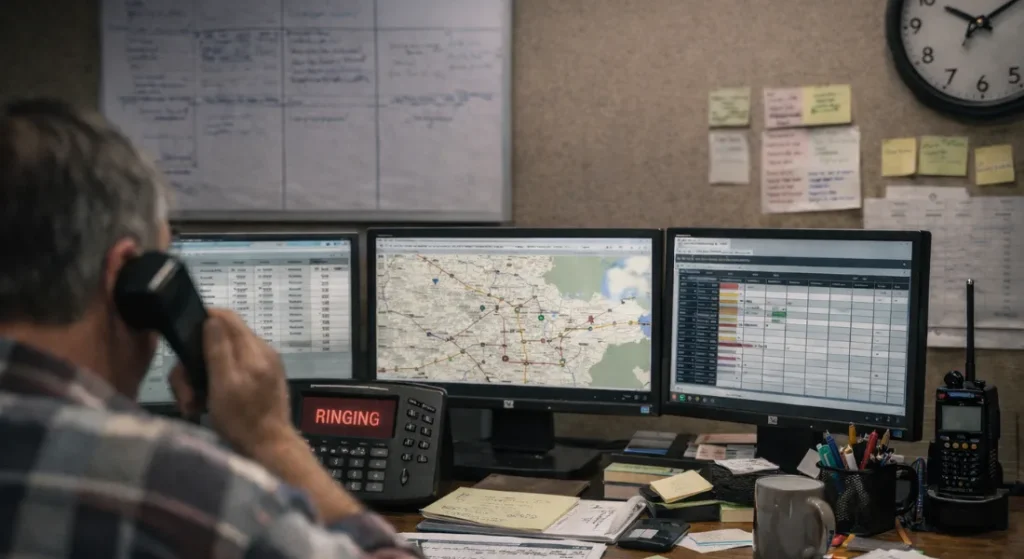
Dispatcher Time Management and the Biggest Time Drains No One Talks About
Most dispatch days don’t cascade into chaos all at once. They get chipped away with a quick call here, a small change there, and by the end of the shift; the schedule looks full, but the actual results don’t match the effort.
This is where dispatcher time management quietly slips. Time is lost in the gaps between loads. Not in big decisions, but in constant interruptions that never get tracked. Over time, those minutes turn into late trucks, longer waits, and higher operating costs.
In this article, you’ll see where those minutes go, why they stack up so fast, and how to spot the patterns that affect decision making, and result in missed loads.
1. Constant Check-In Calls That Don’t Move the Schedule
A lot of time gets lost here without anyone noticing. Not in long conversations, but in short ones that keep repeating.
Dispatchers take calls from customers asking where a truck is, if it is empty, or if a ticket has been signed. Each call feels harmless on its own. The problem is that It’s just another interruption. They add up and every interruption breaks focus and requires the dispatcher to pause whatever planning was in progress.
Over a full shift, those interruptions add up. The schedule is opened and viewed repeatedly, and decisions that should have taken seconds start taking much longer. Some fleets reduce this pressure by leaning on real-time driver status updates, so calls are saved for issues that actually need discussion instead of basic location checks.
2. Rescheduling That Never Fully Finishes
Rescheduling rarely feels like a single decision. It happens in small increments that add up throughout the course of the day.
A load gets pushed back. Another job is adjusted just enough to keep it moving. One more job is pushed out to be dealt with later. The schedule stays open, but progress doesn’t go as planned, and many of the jobs remain on schedule to be completed another day.
Over time, dispatch inefficiencies show up in predictable ways:
The same orders get reopened multiple times
Adjustments are made without seeing the full day
Small fixes crowd out better planning
When schedules are built in pieces, they require constant attention. Keeping orders and schedules aligned from the start reduces how often dispatchers have to circle back and patch things together mid-shift.
3. Chasing Drivers for Status Instead of Managing Flow
At some point, dispatching shifts from planning to checking in. That shift is subtle, but it changes the entire day.
Instead of managing the flow of trucks, dispatchers spend time calling drivers to ask for updates. This is common in manual dispatch processes where information only moves when someone asks for it. Updates arrive late or incomplete, and small timing issues turn into hauling delays that affect other loads.
Once this pattern sets in, the dispatcher becomes an information collector instead of a scheduler. Many teams try to lessen this by reducing back-and-forth between dispatchers and drivers, so updates come in without stopping the rest of the work.
4. Correcting Job Details After the Day Has Started
Some delays don’t start on the road. They start with small gaps in job details.
Once trucks are already moving, even small corrections cost more time than expected:
A slightly wrong location sends a driver the long way
Missing notes trigger calls back to the office
Late changes slow down the next dispatch decision
Each fix pulls attention away from the rest of the schedule. One correction leads to another, and the day gets heavier as it goes. Many teams work to limit this by focusing on clean job details starting at the quote level, so fewer issues surface once trucks are already on the road.
5. Reacting to Delays Instead of Seeing Them Early
By the afternoon, the tone often changes. The day becomes more about reacting.
A truck sits longer than expected. Trucks are backed up at a load site. Traffic is more congested on the route. The dispatcher finds out after the delay widens and begins to affect other jobs planned for that day. Decisions get rushed, and small gaps turn into dispatch bottlenecks that are hard to unwind before the shift ends.
This is where end-of-day instability sets in. Loads pile up late, drivers wait, and the schedule feels fragile. Some operations try to get ahead of this by seeing job status before delays stack up, so issues are quickly visible while there is still time to adjust instead of scrambling.
When delays are noticed early, the day bends instead of breaking.
How Small Interruptions Compound into Bigger Problems
On their own, most interruptions feel easy to handle. A quick call. A small correction. A short delay that feels contained.
Together, they create a pattern that quietly drives dispatch inefficiencies that result in missed loads:
Short interruptions → broken focus
Broken focus → slower decisions
Slower decisions → hauling delays
Hauling delays → missed loads
Missed loads → higher cost per mile
None of this shows up as a single mistake or obvious failure. It shows up as, “We were busy all day, but still fell behind.”
This is how dispatching bottlenecks form without warning. Time loss does not hit all at once. It spreads across the day in small pieces, stretching cycle times across the same trucks and routes. To see how this plays out operationally; is to understand how small delays stretch cycle times long before anyone notices a problem on paper.
Why Dispatchers Feel Burned Out Without Knowing Why
Dispatcher time management doesn’t break down because of laziness or lack of skill. It breaks down because of a fragmented process for how jobs are managed.
The day is reactive
Information arrives late
Every answer requires a call
Small fixes never stop coming
The dispatcher isn’t bad at the job. The job is filled with untracked work that never gets counted.
Start Managing Time the Way Loads Are Managed
Most dispatcher time management problems don’t come from lack of effort or skill. They come from untracked work. Check-in calls that break focus. Reschedules that never fully settle. Delayed information updates that force reaction instead of planning.
When time is treated as part of the operation, those patterns become easier to see. Dispatch inefficiencies show up earlier. Hauling delays are less random and missed load opportunities stop creeping in near the end of the day.
Dump Truck Dispatcher is built to help dispatchers spend less time reacting and more time managing the day. If you want to see how it fits into real dispatch work, you can schedule a demo and walk through it without pressure.
Better days start with knowing where the minutes go.
Time is lost in the gaps between loads. Not in big decisions, but in constant interruptions that never get tracked. In this article, you’ll see where those minutes go, why…
If you run trucks long enough, DOT inspections stop feeling rare. They become part of the job. What catches many fleets off guard is not the inspection itself, but the…
If trucks are running all day, but load counts still come up short, the issue is rarely effort or availability. More often, it comes down to hidden cycle time delays…